

Green Tag RFID in sustainability reporting
Green Tag RFID in sustainability reporting
In sustainability reporting, Green Tag RFID finds a clear and regulated position within the framework defined by the ESRS, through which the European Union has established a precise information perimeter for reporting that is comparable and verifiable over time. In this context, the adoption of tags designed according to environmental impact reduction criteria makes it possible to document, in an even more structured and comprehensive way, information that is relevant for ESG (Environmental, Social and Governance) purposes. In short, the use of Green Tag RFID enables companies to govern and report also on the impact of the identification component itself.

What changes in sustainability reporting with the ESRS
The contextual premise is that, as part of the implementation of the Corporate Sustainability Reporting Directive (CSRD), the European Commission has entrusted EFRAG (European Financial Reporting Advisory Group) – the technical advisory body responsible for translating European regulatory objectives into standards applicable by companies – with the task of defining the new European Sustainability Reporting Standards.
The first set of ESRS was adopted through a delegated act in July 2023, with progressive application starting from financial years beginning on 1 January 2024 for large companies already subject to the CSRD. Subsequently, a gradual alignment is envisaged for the other categories of companies covered by the directive.
In summary, the ESRS define the scope and structure according to which companies must prepare their sustainability reports, establishing common criteria for comparability, verifiability and consistency over time, and specifying metrics as well as quality and reliability requirements for reported data.

The ESRS application roadmap clarifies that the reporting obligation extends progressively, starting with large enterprises and listed SMEs. Looking ahead, the ESRS framework is intended to become an increasingly broad reference also for all other categories of companies, serving as a de facto standard for measuring and communicating sustainability performance.
Why Green Tag RFID become reportable under ESRS E5
Within the ESRS regulatory framework, ESRS E5 is the thematic standard dedicated to resource use and the circular economy.
The number 5 identifies the scope relating to the use of resources and the management of material flows throughout the life cycle of products, packaging and assets.
From an operational perspective, ESRS E5 requires companies to demonstrate:
- how resources enter operational processes
- how they are used and reused
- with what outcomes they exit the operational cycle in the form of products, scraps or waste
The key point is that, with the entry into force of the new regulation, it is no longer sufficient in sustainability reporting to merely declare the adoption of certain solutions. This also applies to IoT systems: companies must demonstrate, through concrete and verifiable data and parameters, how technological and operational choices affect resource use, waste reduction and the management of the entire life cycle of the adopted solutions.
ESRS E5 metrics
The metrics required by ESRS E5 must describe, in a structured manner, a number of specific dimensions:
Resource inflows
Which material resources enter business processes, in what quantities and with which characteristics. This includes not only raw materials, but also components, packaging and operational supports, which fully fall within the resource use cycle.
Resource use and circularity strategies
How resources are used over time, whether and to what extent they are reused, and with what effects on the duration of operational cycles. From this perspective, circularity is a dynamic that must be observed and measured throughout the entire life cycle of assets and supports.
Resource outflows and waste
What exits the processes in the form of products, scraps or waste, and their respective destinations. Reporting must allow a clear distinction between reuse, recycling and disposal, making transparent how resources are managed in the final phase of the cycle.
Evolution over time
Metrics must enable comparisons across different periods, highlighting improvements or deteriorations in resource use cycles. Temporal comparability therefore becomes a necessary condition for assessing whether circularity strategies are delivering concrete results.
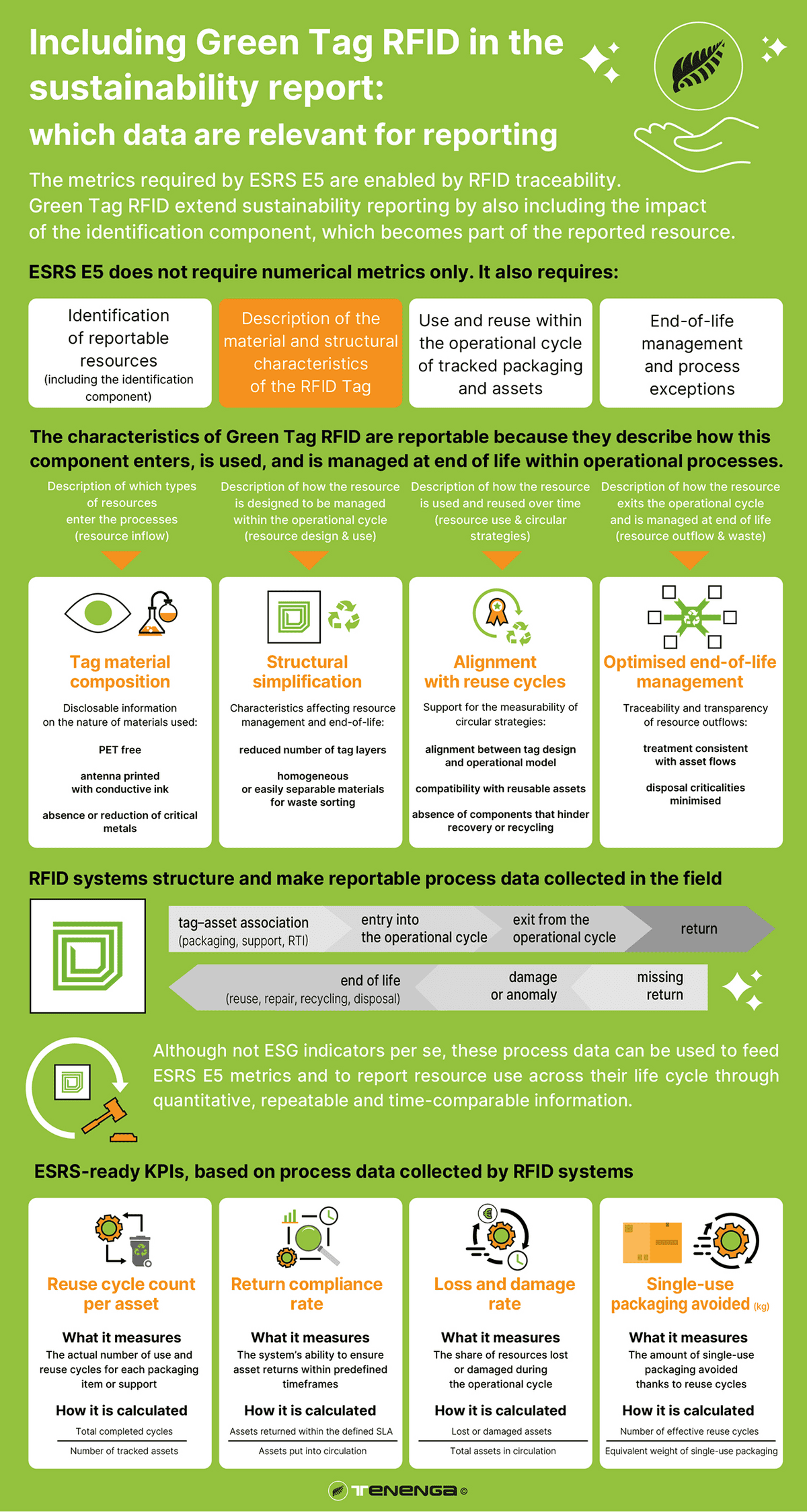
Green Tag RFID transform operational events into verifiable metrics, including the impact of identification within the ESG perimeter.
The physical component of Green Tag RFID as a first level of reporting
In sustainability reporting, the value of Green Tag RFID does not lie solely in supporting process measurement, but extends to the ability to document, in a concrete and measurable way, design choices that affect the material composition and life cycle of the identification component.
A first dimension concerns the physical component of the tag.
- The PET-free approach directly affects the composition of the substrate, reducing the use of plastic materials that complicate end-of-life management.
- The use of antennas manufactured through conductive ink printing technologies, instead of metal-based solutions such as aluminium, affects both the type and quantity of materials used, further reducing the overall life-cycle impact profile.
- Printing and assembly processes also play a role, as solutions designed to simplify the structure of the tag help reduce the energy intensity associated with production.
These aspects make Green Tag RFID consistent with the sustainability logics that today guide many supply chain decisions. They are not declarative “green” attributes, but observable and describable technical characteristics that can be documented and included within the perimeter of reportable environmental information, starting from the description of the resources used and the design choices adopted.
Alongside this design dimension, there is a second, informational dimension. The unique identification enabled by RFID tags allows for the continuous collection of process data within logistics and industrial flows. Usage and reuse cycles of packaging and supports, dwell times within processes, returns, losses and anomaly management become structured information when they are tracked consistently and according to coherent rules.
In this way, operational data does not remain confined to efficiency purposes alone, but can be used as reportable evidence, supporting sustainability reporting items related to circularity, resource use and the management of waste and losses along the supply chain.
From sustainability reporting to packaging compliance
Alongside the ESRS, the traceability of packaging and logistics supports is set to become increasingly relevant also in light of the Packaging and Packaging Waste Regulation (PPWR).
The European packaging regulation strengthens the focus on reuse, recycling, end-of-life management and waste reduction, requiring companies to demonstrate, in a structured manner, how packaging is used throughout operational cycles and how it is managed at end of life.
From this perspective, the information required by the PPWR overlaps directly with the dimensions already addressed by ESRS E5. Packaging and support traceability makes it possible to:
- distinguish between actual reuse, recycling and disposal
- monitor the performance of reusable systems
- make exceptions along the cycle visible, such as losses, damage or non-compliance
These are precisely the elements that packaging regulation makes more relevant, because they transform packaging management from a statement of intent into an observable and verifiable process.
In this sense, data generated by Green Tag RFID associated with more sustainable packaging do not only support ESRS reporting requirements but also anticipate the needs of a broader regulatory context, in which packaging management is interpreted as an integral part of circularity strategies and waste reduction.
The ability to link use, returns, reuse and end-of-life of packaging to time-based traceability data therefore becomes an enabling factor both for sustainability reporting and for future packaging compliance requirements.